Welcome to our blog featuring updates, news, and perspectives on graphene and related two-dimensional materials.
-
Destination Genoa
Last March we had a great edition of the Graphene conferences. Graphene 2015 took place at the Bilbao Exhibition Centre from March 10-13 (2015), a great location for the large number of participants who enjoyed the talks by some of the most inspiring speakers in the field. Personally, my favorite ones were those by Antonio Castro Neto (From graphene to phosphorene: The 2D zoo) and Luigi Colombo (2D Materials Growth: Prospects and Challenges). By the way, don’t miss this interesting interview with Prof. Luigi Colombo made by ICN2 - Barcelona.
Read more → -
Graphene Canada 2015
Montreal (Canada) will host the 1st edition of the Graphene & 2D Materials International Conference and Exhibition: October 14-16, 2015.
The Graphene Conference will be a 3 days event that meant to gather the key players of the Graphene Community and related sectors. This event is launched following the lack of meetings in the field in Canada and aim to become an established event, attracting global participant’s, intent on sharing, exchanging and exploring new avenues of graphene-related scientific and commercial developments.
Read more → -
Announcement "ICREA Workshop on Graphene Nanobiosensors - May 2015"
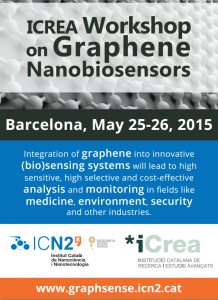 The Workshop on Graphene Nanobiosensors will take place in Barcelona from May 25 to May 26, 2015. This unique event will bring together the most relevant scientists working in fields related to the design of nanobiosensors and nanobiosystems based on graphene.
Do not miss this opportunity! For more information visit: http://graphsense.icn2.cat/
Read more → -
Before new year's break
This has been a hectic year full of great discoveries and developments in the field of graphene and other 2D materials. But now we wanted to propose our readers to take a breath and make a ludic stop.
Following Symmetry Magazine we are proposing to turn into the art of cutting paper snowflakes. These are not, however, ordinary snowflakes, they feature Paul Dirac and six Dirac cones!

You will need scissors (a cutter may also help) and to print the pdf attached to this post.
Read more → -
Nature Nanotechnology celebrates 10 years of graphene and more
A day like today in 2004 the famous paper by Geim and Novoselov appeared in Science. Nature Nanotechnology celebrates this with a Focus on Graphene Applications. You may take a look at it here.
The readers interested in graphene applications may also profit from the Graphene Roadmap presented in the latest issue of Nanoscale : “Science and technology roadmap for graphene, related two-dimensional crystals, and hybrid systems” [link]
Furthermore, the research on graphene and the related materials keeps bringing more surprises. Here we mention a few of them:
Read more → -
Announcement of "Graphene 2015: 10th-13th March in Bilbao"
The 5th edition of Graphene International Conference will take place in Bilbao (Spain) between the 10th and the 13th of March 2015. More info soon.
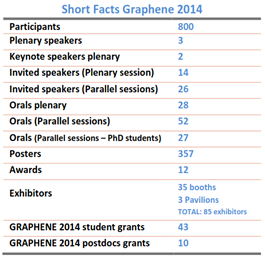
This meeting will follow the overwhelming success of the last editions. Some numbers of the latest meeting in Toulouse are included below:
Conference web-site: http://www.grapheneconf.com/
Read more → -
Talk to the editors: Publishing your graphene research in Nature and PRL
Getting published in top journals may be crucial for advancing in your career. In the first video (posted by the Graphene Flagship), the editors of Nature Physics, Materials and Nanotechnology talk about their journals and how graphene/2D materials research fits in. The second video is a very interesting interview with PRL Editor Dr. Samindranath Mitra. Dr. Mitra is in charge of papers on transport properties in semiconductors, 2D materials, and mesoscopic systems at Physical Review Letters.
Read more → -
Stephan's recursion methods
One of the most efficient methods available for computing the Density of States (DoS) and the transport properties, specially in samples containing a large number of atoms, is the recursion method explained in Appendix D of “Introduction to Graphene-based Nanomaterials”. Here we provide (by courtesy of Stephan Roche) a numerical code written in fortran and implementing this method for graphene and carbon nanotubes.
To get your link to download the code with Stephan’s recursion methods please send an email containing a proof of ownership of your book (invoice, photo with your book, or equivalent) to introductiontographene at gmail.com
Read more → -
Recursive Green's functions and self-energies
Here we provide a simple fortran 90 code that implements the recursive Green’s functions techniques for calculating the self-energy of a semi-infinite lead as described in Appendix C of “Introduction to Graphene-Based Nanomaterials”. To call this routine you must provide an array with matrices containing the hoppings between the layers as well as the diagonal block matrices of the Hamiltonian.
This should serve to give you an idea of a possible implementation. Of course, this can also be done in Python for example (if you are interested just drop a line to Luis Foa Torres).
Read more → -
Graphene news (June's update)
Research on graphene-based materials seems to be getting to a new level of activity. Indeed, we have witnessed an impressive set of experiments since our last update in March. This time one of the magic words is ‘control’. Electrical control of the stacking between layers in trilayer graphene [1]; optical control in the case of the photo-induced doping achieved in Ref. [2]; control of graphene plasmons [3] and of the interaction with a substrate [4]. One should also mention a few of the best available images of defects in graphene (line-defects [5] and vacancies in ion irradiated samples [6]) and the puzzling observation of length-dependent thermal conductivity [7]. We would also like to mention a review on a hot topic: Transport and Grain Boundaries in Poly-crystalline Graphene [8].
Read more → -
ABINIT input files for graphene nanoribbons
ABINIT input files for armchair and zigzag graphene nanoribbons (by courtesy of Jean-Christophe Charlier). These inputs allow to calculate the structural and electronic properties of these GNRs (including spin-polarization in the zigzag case due to the potential magnetization at the edges). The PAW pseudopotentiels for carbon and hydrogen are also included.
agnr.in zgnr.in 1h-gga-uspp.paw 6c-gga-uspp.paw
Read more → -
Python packages for graphene-based materials and beyond
Python is one of the most versatile languages for coding. It allows fast coding of complex algorithms and the community working with Python is growing at a fast pace.
Here we recommend two packages written for python:
-
PythTB : Python Tight-Binding is a package developed at Rutgers University by the group of David Vanderbilt. It allows to compute the electronic structure and topological properties of nanomaterials (1d, 2d or 3d) in an elegant way.
Read more → -
And the winner is... <br> (the draw for our first 100 subscribers)
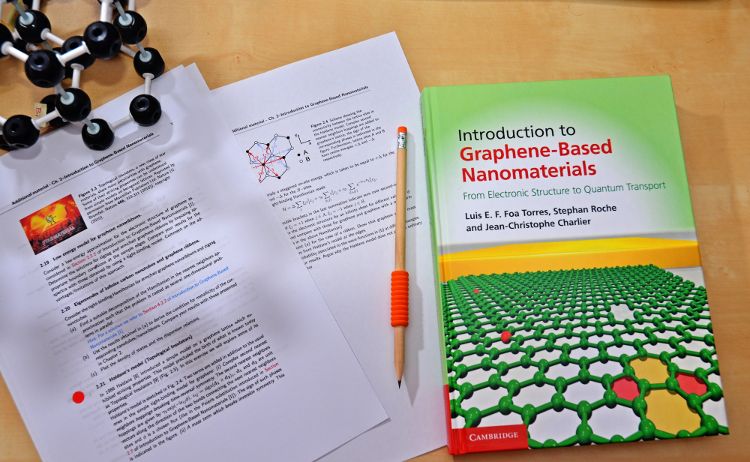
As announced earlier this year, the first subscribers to our newsletter participated in a draw for a free copy of Introduction to Graphene-Based Nanomaterials. We are very happy to announce that the draw took place on March 4th and the winner is… Massimo Spina who is a PhD student at EPFL (Lausanne). Congrats Massimo! Your book is on the way…
In the meantime the book has been published and is now available in Europe and Asia and is scheduled to be released very soon in the Americas. Please do not forget to check out the online material available here. We will keep expanding it in the following weeks.
Read more → -
A few breaking news in two dimensions (March update)
Research on graphene and the related materials has shown several impressive studies over the last months. From the first transmission of the name “IBM” being received by a radio chip made of graphene, to the puzzling observation of exceptional ballistic transport in epitaxial graphene, there seems to be plenty of exciting news in this area. As a way to update on the literature, here we provide links to a few of the most remarkable studies.
Read more → -
Customized "Table of Instructions" now available online
A few days ago we made available a customized Table of Instructions * with extra tips for your path through the book. Since many of you come from very different areas and/or have different aims, we believe that this may be of help. To get yours just answer the questionnaire here.
Read more →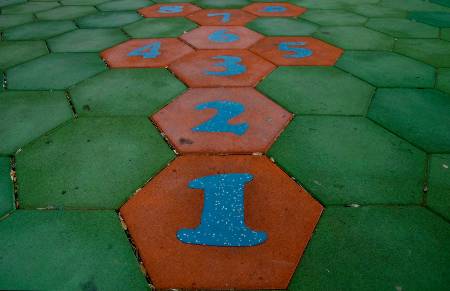 Hop through the chapters of the book following your “Table of Instructions”. The image is from istockphoto and features a hopscotch board on a playground.
 -
Welcome!

Hi, and welcome to introductiontographene.org. This is the online companion for our book “Introduction to Graphene-Based nanomaterials” published by Cambridge University Press (If you didn’t pre-order your copy yet you can do it here).
As new extras, updates and blog posts on breaking news on graphene and related nanomaterials will be gradually released, we recommend you to subscribe to our newsletter here (updated 8-12 times a year) not to miss any update. It takes only 23 seconds, no registration is required. The first 100 subscribers will be participating in a draw for one signed copy of the book (hardback).
Read more → -
Cargèse International School 2014: “Frontier Research in Graphene-based Systems" (New: Take a look at the Lectures!)
The Cargèse International School 2014 on “Frontier Research in Graphene-based Systems" took place betweenApril 8th and April 18th 2014.
Main topics included:
-
Graphene, Carbon Nanotubes, Graphene nanoribbons, Carbon-‐based nanostructures.
-
Other 2D materials (exfoliable compounds), hybrid carbon-‐based nanostructures,
PDF-files of all lectures can be uploaded freely at
http://www.graphene-nanotubes.org/en/graphene-school-2014/lectures-2.html
Read more → -
-
Announcement of "Graphene 2014: 6th-9th May in Toulouse"
Read more →Toulouse (France) will host the 4th edition of Graphene Conference series, the largest European Event in Graphene , from the 6th until the 9th of May 2014 at Centre de Congres Pierre Baudis. A Plenary session with internationally renowned speakers, extensive thematic workshops in parallel, an important industrial exhibition carried out with the latest Graphene trends and a brokerage event will be some of the features of this event.
-